AI vs Manual Workflows: Scaling Healthcare Operations
Healthcare Technology
Updated Mar 29, 2026
AI automates intake, claims, and scheduling to cut costs, reduce errors, and scale healthcare operations while easing staff workload.
In healthcare, administrative inefficiencies cost the U.S. $900 billion to $1.2 trillion annually. Manual workflows - like patient intake, insurance verification, and scheduling - are slow, error-prone, and expensive. They also contribute to staff burnout, with nearly half of hospitals reporting vacancy rates above 10%. AI-powered workflows solve these issues by automating repetitive tasks, reducing errors, and cutting operational costs. For example, AI can reduce patient intake time from 15–20 minutes to under 90 seconds, while lowering costs to less than $2 per patient.
Key Insights:
Time Savings: AI completes tasks in seconds that take staff hours weekly.
Cost Efficiency: AI reduces intake costs from $5–$8 per patient to under $2.
Error Reduction: AI achieves 94%+ accuracy vs. 61% for manual data entry.
Scalability: AI handles growing patient volumes without hiring more staff.
AI-powered systems streamline healthcare operations, allowing organizations to handle more patients, reduce costs, and improve accuracy - all while easing staff workloads.
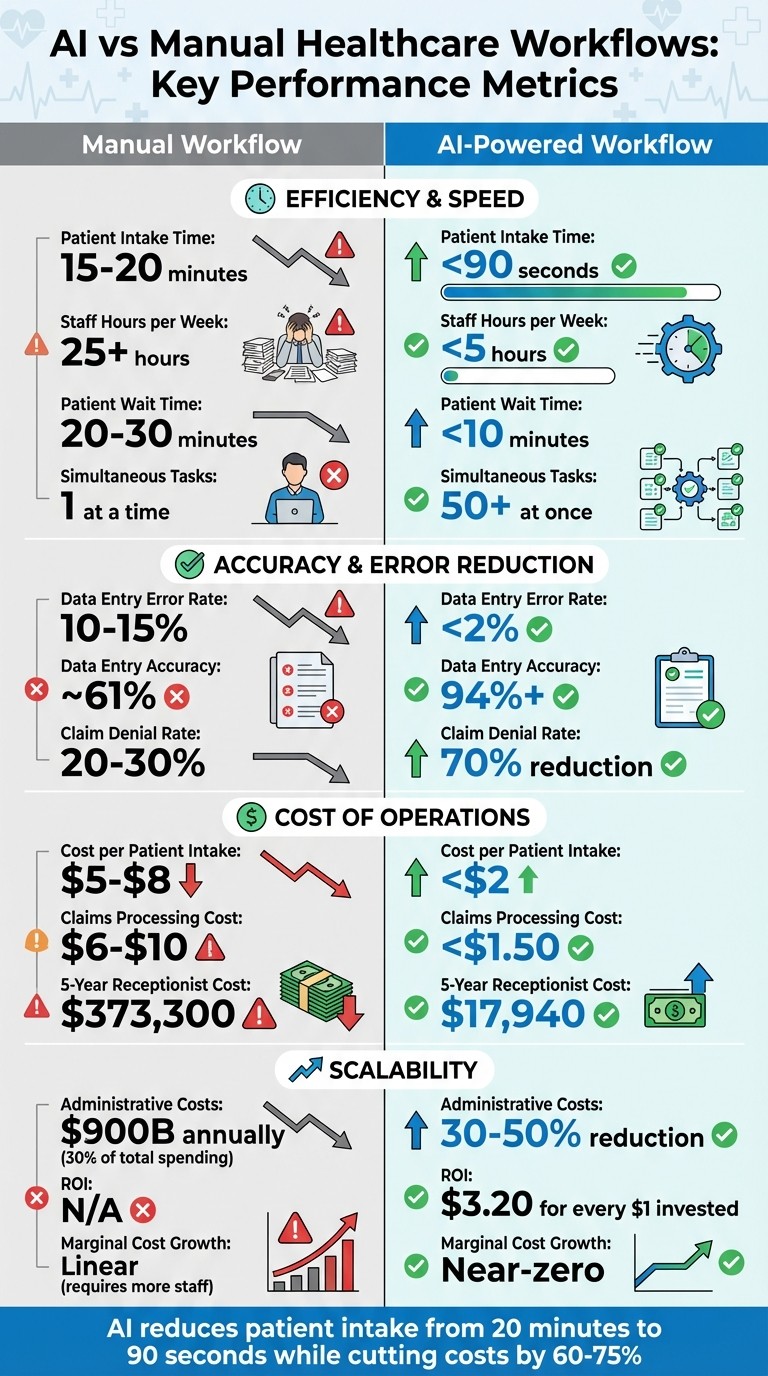
AI vs Manual Healthcare Workflows: Cost, Speed, and Accuracy Comparison
How AI is Transforming Healthcare Workflows | DocMagic by Cyret Technologies
Comparing Manual and AI-Powered Workflows: Key Metrics
Building on earlier challenges, let’s dive into a detailed comparison of manual and AI-powered workflows across four key areas: efficiency and speed, accuracy and error reduction, cost of operations, and scalability. These metrics provide a clear framework for healthcare organizations deciding between traditional processes and automation.
Efficiency and Speed
Manual workflows rely on a step-by-step approach. For example, a receptionist can only tackle one task at a time, which creates bottlenecks. In contrast, AI-powered workflows excel through parallel processing. They can manage over 50 tasks simultaneously, drastically reducing patient intake times. What might take 15–20 minutes manually can be completed in under 90 seconds using AI automation [1][6].
Metric | Manual Workflow | AI-Powered Workflow |
|---|---|---|
Intake Time | 15–20 minutes [6] | |
Staff Hours | 25+ hours/week [6] | Less than 5 hours/week [6] |
Patient Wait Time | 20–30 minutes [6] | Under 10 minutes [6] |
Simultaneous Tasks | 1 at a time [7] | 50+ at once [7] |
This speed advantage is just the beginning. Next, let’s explore how AI reduces errors and improves accuracy.
Accuracy and Error Reduction
Human error is an unavoidable part of manual workflows. Fatigue, distractions, and multitasking challenges often result in mistakes. Manual data entry, for instance, has an accuracy rate of about 61%, with error rates ranging from 10–15%. On the other hand, AI systems achieve over 94% accuracy, with error rates dropping below 2% [6][9].
The financial consequences of these errors are staggering. Manual data entry issues contribute to an estimated $2.5 billion in annual rework costs across U.S. healthcare [6]. Fixing a single denied claim can cost between $25 and $117, and 65% of denied claims are never resubmitted, directly impacting revenue [8].
AI systems help by validating data at the source - checking demographics, insurance details, and required fields before the information reaches the EHR. This reduces errors and minimizes the need for costly rework, streamlining operations and improving outcomes.
Metric | Manual Workflow | AI-Powered Workflow |
|---|---|---|
Data Entry Error Rate | 10%–15% [6] | Less than 2% [6] |
Data Entry Accuracy | ~61% [9] | 94%+ [9] |
Claim Denial Rate | 20%–30% [10] | Reduced by 70% [10] |
Now, let’s look at how these accuracy improvements translate into cost savings.
Cost of Operations
Manual workflows follow a predictable but expensive pattern: as patient volumes rise, more staff must be hired. Each new hire adds salary, benefits, and training costs. For example, employing a human receptionist over five years costs around $373,300, while an AI receptionist costs approximately $17,940 in the same period [9].
AI workflows also scale efficiently. Processing 1,000 tasks costs about the same as processing 100, keeping expenses low even as demand grows [7]. The average cost of manual patient intake ranges from $5 to $8 per patient, compared to significantly lower costs with automation [6]. Additionally, AI captures revenue opportunities by handling after-hours appointments, recovering over $13,000 monthly in otherwise lost revenue [9].
Metric | Manual Workflow | AI-Powered Workflow |
|---|---|---|
Cost per Intake | $5–$8 per patient [6] | Less than $2 per patient [6] |
Claims Processing Cost | $6–$10 per claim [10] | <$1.50 per claim [10] |
5-Year Receptionist Cost | $373,300 [9] | $17,940 [9] |
These comparisons highlight how AI-powered workflows not only improve efficiency and accuracy but also deliver significant cost savings, making them an attractive option for healthcare organizations looking to scale effectively.
Manual Workflows: Scaling Challenges in Healthcare
Manual workflows in healthcare reveal a glaring issue: they simply don't scale well. As patient numbers grow, the reliance on human-dependent processes leads to mounting inefficiencies and operational headaches.
Administrative Bottlenecks
One of the biggest hurdles is the lack of integration between systems. Despite the adoption of digital tools, many healthcare technologies operate in silos, forcing staff to act as the bridge between systems. This means manually transferring data between electronic health records (EHRs), billing platforms, and scheduling tools - a process that eats up valuable time. Experts often refer to this as a "human orchestration layer", where routine tasks turn into tedious bottlenecks.
Take a single referral, for example. It can involve up to 17 manual steps, including verifying insurance, checking specialist availability, documenting in multiple systems, and following up repeatedly [2]. On top of that, staff spend 15 to 20 hours per week just handling phone calls for scheduling and reminders [12]. Add in manual data entry (5–8 hours), insurance checks (4–6 hours), and billing follow-ups (3–5 hours), and the total administrative workload balloons to 30 to 44 hours per week [12].
"Healthcare is drowning in data but starved for connection. Each clinic, hospital, lab, pharmacy, and insurance company operates within its own technological silo." - Nasar Haq, CEO, Medtransic [3]
As organizations scale, these inefficiencies grow exponentially. The result? Staff spend more time on paperwork and less time focusing on patients, leading to delays and frustration across the board.
Staff Burnout and Turnover
The human toll of manual workflows is just as concerning. Front-desk staff, often the first point of contact for patients, face an unrelenting stream of repetitive tasks and inquiries. Over time, this leads to emotional exhaustion. Burnout rates among non-clinical healthcare staff, including receptionists, have reached a staggering 45.6% [13]. Even worse, medical receptionist turnover averages 38% per year, largely due to the pressure of these administrative burdens [14].
The financial impact of turnover is equally troubling. Replacing a single healthcare employee can cost between $30,000 and $50,000, factoring in recruitment, training, and lost productivity [12]. Meanwhile, call volumes to medical practices have surged by 45% between 2019 and 2024, while staffing levels have dropped by 12% [13]. Fewer staff handling more work only compounds the problem.
"Burnout among healthcare professionals isn't caused by a lack of intelligent technology; it stems from excessive, unnecessary interactions that consume valuable time and detract from patient care." - Andrew Torrey, Senior Client Partner, Dualboot Partners [5]
When experienced staff leave, they take critical knowledge with them, leaving new hires to navigate complex processes with little guidance. This cycle of burnout and turnover destabilizes operations, making it even harder for healthcare organizations to grow sustainably.
Compliance and Accuracy Risks
Manual workflows don't just slow things down - they also introduce compliance and accuracy risks. Human error becomes almost inevitable when staff are juggling multiple tasks, especially under pressure. For instance, 30% of medical claims are denied because of mistakes in coding or data entry [11]. In fact, inaccurate patient information accounts for 61% of rejected health insurance claims [11].
The financial cost of these errors is steep. Reworking a single denied claim now costs an average of $57.23, a 30% increase from the previous year [15]. Correcting these claims can take 45 to 60 days, delaying cash flow and diverting staff from more impactful work [11]. Overall, 86% of claim denials stem from poor documentation, and 3% to 5% of total revenue is lost to billing errors in manual processes [16][15].
On a broader scale, U.S. healthcare organizations spend an estimated $39 billion annually to comply with federal and state mandates such as HIPAA [14]. Manual systems make it harder to maintain reliable audit trails and ensure workflows meet regulatory standards [11]. As organizations expand, the sheer volume of manual tasks increases the likelihood of compliance violations - not because staff are careless, but because the workload becomes unmanageable.
These risks underscore a harsh reality: manual workflows aren't just inefficient - they're a liability. As healthcare organizations grow, the cracks in these processes only widen, making it harder to keep up with both operational demands and regulatory requirements.
AI-Powered Workflows: Scalable Healthcare Solutions
AI-powered workflows address the inefficiencies of manual systems by providing scalable, cost-efficient alternatives. Instead of hiring more staff to manage increasing patient volumes, AI automates repetitive tasks, allowing healthcare organizations to grow without the steep costs associated with expanding their workforce. This adaptability aligns with the evolving needs of healthcare providers.
24/7 Workflow Automation
AI operates continuously, handling tasks even outside of standard business hours. With 67% of patients preferring online booking and 40% attempting to schedule appointments after hours [17], manual systems struggle to keep up without adding night or weekend shifts. AI-powered receptionists, like those from Lead Receipt, bridge this gap by managing calls, scheduling, and lead handling around the clock.
The results speak for themselves. AI receptionists can reduce missed calls by 30–50% and boost appointment bookings by 15–25% [17]. Additionally, the time required for patient intake drops dramatically - from 15–20 minutes to just 90 seconds with AI automation [1][6]. This not only speeds up processes but also allows staff to focus on more complex, high-value tasks rather than answering routine questions repeatedly.
Integration with Existing Systems
AI solutions are designed to work seamlessly with existing infrastructure. They integrate directly with EHRs, CRMs, and scheduling platforms, enabling real-time insurance verification, automated eligibility checks, and smooth data transfers. This eliminates the need for manual data entry and reduces errors caused by siloed systems.
For example, Northfield Hospital + Clinics implemented EHR-connected AI to handle manual fax processing and patient outreach. The result? They saved over 250 hours per month on fax handling and achieved real-time capacity balancing for urgent care across multiple locations [4]. This kind of integration doesn’t just save time - it fundamentally improves operational efficiency, making it easier to scale as demand grows.
Scaling with Business Growth
AI provides a cost-effective pathway for long-term growth. Unlike manual workflows, which require hiring more staff as patient volumes increase, AI scales at near-zero marginal cost [7]. This means organizations can handle more patients without incurring the significant expenses tied to salaries, benefits, and training. In fact, AI adoption can lead to a 30–50% reduction in operational costs compared to traditional staffing models [17].
The financial benefits are clear. Manual patient intake costs $5 to $8 per patient, while AI-driven intake costs less than $2 per patient [6]. As patient numbers grow, these savings add up quickly. Considering that administrative tasks account for 30% of total U.S. healthcare spending - around $900 billion annually [1] - even partial automation can create substantial cost reductions for healthcare providers.
AI also ensures consistent performance as organizations scale. Unlike manual processes, where quality can decline under heavy workloads, AI maintains the same level of accuracy and efficiency, whether managing 10 patients or 10,000. This reliability is crucial for maintaining compliance, minimizing errors, and ensuring every patient receives high-quality service, no matter the circumstances.
AI vs Manual Workflows: Scaling Healthcare in Practice
When it comes to handling high volumes in healthcare, AI offers clear advantages in cost and efficiency. Manual systems rely heavily on human input, meaning every new patient, call, or inquiry demands additional labor, driving up costs and creating bottlenecks. AI-powered workflows, on the other hand, can handle increased demand without the proportional rise in expenses tied to hiring more staff.
High-Volume Lead Management
Managing patient inquiries manually becomes increasingly expensive as call volumes grow. For every surge in patient inquiries, clinics often need to hire additional full-time staff. For example, doubling call volume typically requires hiring another employee, adding $30,000–$41,000 annually to operating costs[13]. This not only strains budgets but also places heavy workloads on front-desk staff, increasing the risk of burnout[13].
Even small inefficiencies can lead to significant losses. Let’s say a clinic generates $132,000 per month in revenue. If just 3% of patient inquiries are missed due to unanswered calls, that translates to a staggering $47,520 in lost revenue annually[7]. Manual workflows often struggle to keep up during peak times, with calls going to voicemail or patients hanging up after long waits. AI-powered systems, capable of handling unlimited simultaneous inquiries, eliminate these gaps and ensure better lead management.
But the impact of AI doesn’t stop at lead management - it also revolutionizes call handling and scheduling during high-demand periods.
Call Handling and Scheduling
As patient volumes grow, the limitations of manual call handling become evident. A human receptionist can only manage one call at a time[18], creating delays when multiple patients call simultaneously. AI receptionists, however, can handle an unlimited number of calls at once[7][18], turning the front desk into a highly efficient, scalable operation.
Timing is another crucial factor in patient engagement. Manual systems often require costly night or weekend shifts to meet after-hours demand. AI systems, by contrast, operate 24/7 without incurring overtime costs. This ensures that after-hours inquiries are captured and patients who prefer online booking are accommodated[17]. The result? Fewer missed opportunities and preserved revenue streams.
AI also significantly reduces errors in processes like insurance verification - by up to 80% compared to manual methods[6]. For clinics scaling from dozens to hundreds of appointments daily, this level of accuracy can mean the difference between smooth operations and overwhelming chaos.
For healthcare providers aiming to scale efficiently, tools like Lead Receipt offer AI-powered solutions to manage high call volumes and scheduling needs, ensuring operations remain seamless even during peak demand.
Conclusion
Choosing between manual and AI-powered workflows is a pivotal decision for healthcare organizations navigating a rapidly growing market. Manual processes often lock businesses into a linear growth model, where increasing patient volumes require proportional increases in staff and payroll. AI disrupts this pattern by enabling near-zero marginal cost scaling, allowing organizations to handle thousands of tasks without corresponding cost hikes[7].
Administrative inefficiencies cost the healthcare industry hundreds of billions annually, with rework expenses adding billions more. AI automation not only slashes these costs but also boosts efficiency - delivering an average ROI of $3.20 for every $1 invested[19]. It can also drastically cut patient intake times from 20 minutes to under 90 seconds[1]. This shift is more than just a financial win; it’s a crucial step for healthcare businesses aiming to scale profitably rather than being constrained by outdated workflows.
Beyond the numbers, AI tackles the human burden of manual processes. Clinicians spend nearly half their time on documentation instead of patient care[19], and staff vacancy rates exceed 10% in nearly half of all hospitals[1]. By automating repetitive tasks, AI allows staff to focus on what truly matters - delivering quality care and building stronger patient relationships.
For organizations ready to embrace this transformation, Lead Receipt offers tailored AI-powered receptionist and workflow automation solutions specifically designed for healthcare. Their 24/7 AI receptionists manage calls, scheduling, and lead processing while seamlessly integrating with existing CRMs and scheduling systems. This eliminates the operational bottlenecks that manual workflows create, removing the ceiling on growth.
The real question isn’t whether to adopt AI-powered workflows - it’s how quickly healthcare leaders can act to remove the inefficiencies holding them back. The future of scalable, efficient healthcare depends on it.
FAQs
Which healthcare tasks should we automate first with AI?
Focusing on automating tasks that are time-consuming, repetitive, and prone to errors can greatly improve efficiency while easing staff workloads. Areas like appointment scheduling, patient intake, billing, and claims processing are prime candidates for automation. For instance, automating appointment scheduling not only reduces administrative expenses but also simplifies workflows. Similarly, streamlining patient intake can save countless employee hours each month. Tackling these tasks first can help remove operational bottlenecks and set the stage for smoother, scalable healthcare processes.
How does AI integration with our EHR and scheduling work?
AI working alongside EHR and scheduling systems simplifies healthcare workflows by taking over tasks like processing patient data, managing appointments, and sending reminders. This not only cuts down on administrative burdens but also boosts accuracy and ensures compliance with HIPAA regulations through features like encryption and secure access controls.
AI-powered tools can also provide round-the-clock online booking, predict patient no-shows, and automate appointment handling. These capabilities improve patient access while making healthcare operations smoother and more adaptable to changing demands.
What safeguards keep AI workflows HIPAA-compliant and accurate?
AI workflows in healthcare prioritize HIPAA compliance and data accuracy through a combination of advanced security protocols and procedural safeguards. Key measures include AES 256-bit encryption, which protects sensitive data, along with role-based access controls (RBAC) and multi-factor authentication (MFA) to restrict access to authorized personnel only.
To ensure transparency, these systems maintain tamper-proof audit trails, allowing for effective monitoring of any unusual activity. Additional protections, such as regular risk assessments, Business Associate Agreements (BAAs) with third-party vendors, and comprehensive staff training, further reinforce the security and reliability of these workflows. Together, these measures create a robust framework for safeguarding patient information.