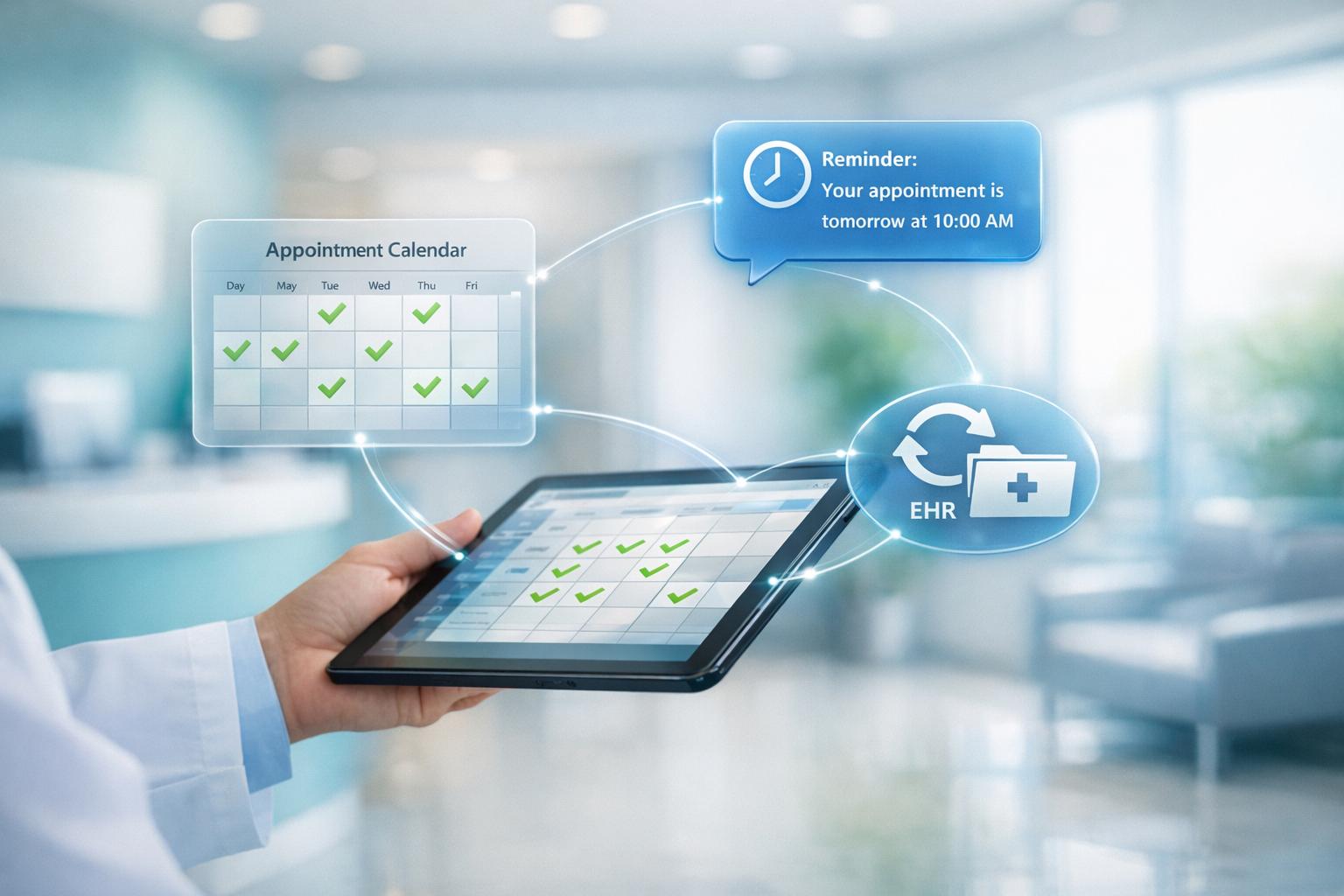
Best Scheduling Tools to Reduce Patient No-Shows in 2026
Healthcare Technology
Updated Mar 17, 2026
AI scheduling tools with automated reminders and EHR sync that cut patient no-shows 30–50% and streamline practice workflows.
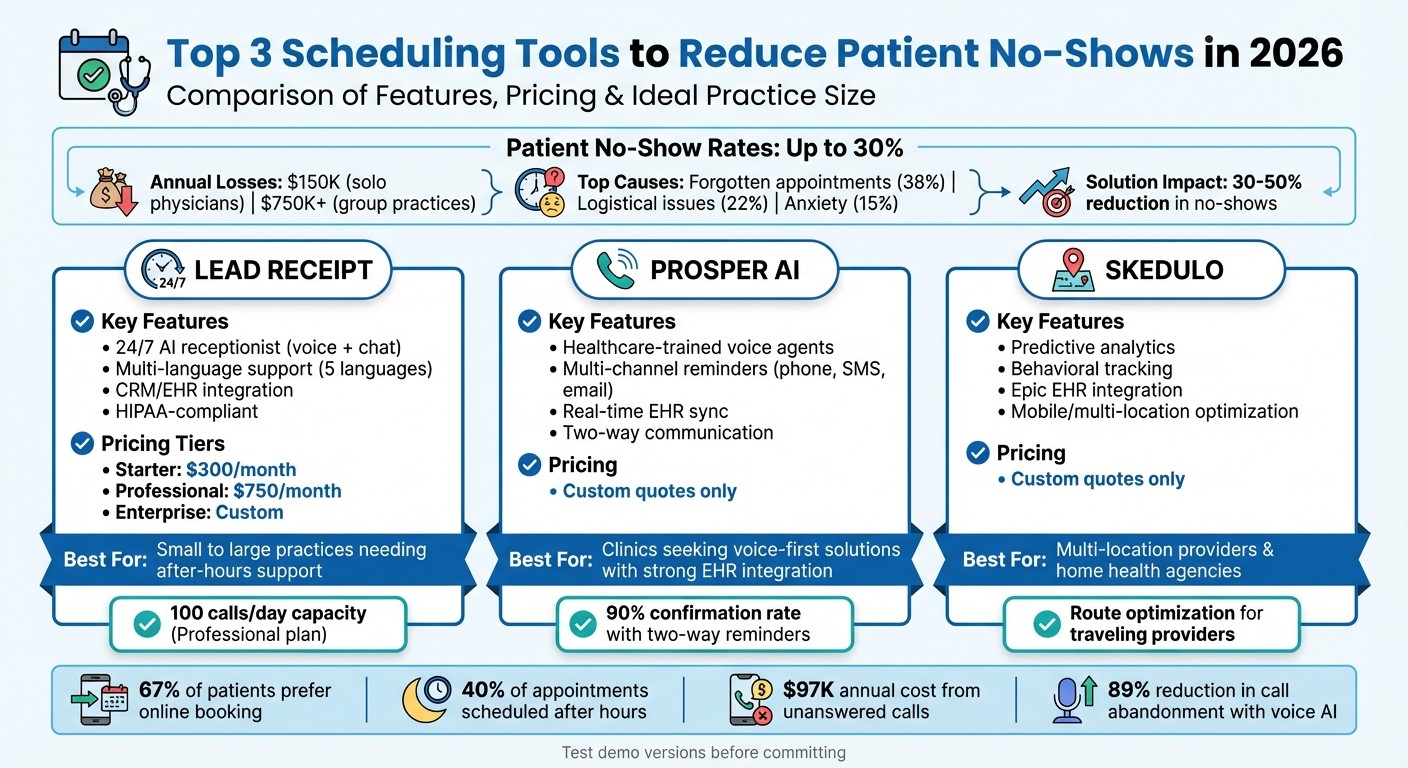
Patient no-shows cost healthcare practices both time and money. With rates as high as 30%, missed appointments can result in annual losses of $150,000 for solo physicians and over $750,000 for group practices. Factors like forgotten appointments (38%), logistical issues (22%), and anxiety (15%) contribute to the problem. Modern scheduling tools address these challenges with features like automated reminders, two-way communication, and real-time updates, reducing no-show rates by 30% to 50%.
Here’s a quick overview of three top tools:
Lead Receipt: A 24/7 AI receptionist offering voice and chat scheduling, seamless CRM/EHR integration, and scalable plans starting at $300/month. Ideal for practices needing after-hours support.
Solution A (Prosper AI): Focused on healthcare-trained voice agents and multi-channel reminders (phone, SMS, email). Best for practices seeking strong EHR integration and real-time rescheduling.
Solution B (Skedulo): Designed for multi-location or mobile providers, with predictive analytics to identify high-risk no-shows and optimize schedules.
Quick Comparison:
Tool | Key Features | Best For | Pricing |
|---|---|---|---|
Lead Receipt | 24/7 AI receptionist, multi-language | Small to large practices | $300–Custom |
Prosper AI | Multi-channel reminders, EHR sync | Clinics needing voice-first solutions | Custom |
Skedulo | Predictive analytics, mobile focus | Multi-location or mobile providers | Custom |
The right tool depends on your practice size, patient needs, and current systems. Testing demo versions can help you find the best fit.
Healthcare Scheduling Tools Comparison: Features, Pricing & Best Use Cases 2026
eCW Podcast: Know Your No-Shows and Optimize Your Schedule
1. Lead Receipt
Lead Receipt acts as a 24/7 AI-powered virtual receptionist, managing scheduling, rescheduling, and cancellations through both voice calls and web chat.
AI-powered automation
This system takes the hassle out of manual data entry by automatically logging patient details into CRMs and forwarding urgent calls directly to staff. It also identifies trends and patient preferences to fine-tune scheduling. By minimizing manual errors and ensuring prompt communication, Lead Receipt helps reduce patient no-show rates - making it a practical tool for maintaining smoother operations[2].
Integration capabilities
Lead Receipt works effortlessly with phone systems, CRMs, and scheduling software, ensuring it fits right into your existing workflow without causing disruptions[2]. It’s fully HIPAA-compliant and employs enterprise-grade security measures to safeguard patient data during automated interactions. With its ability to automatically sync patient records and calendars across platforms, it eliminates the need for staff to juggle multiple systems. These integrations not only simplify daily tasks but also allow practices to select a plan that aligns with their specific size and requirements.
Pricing and scalability
Plan | Price | Key Features | Best For |
|---|---|---|---|
Starter | $300/month | Web-chat, standard analytics, email support | Web-based intake |
Professional | $750/month | Voice & chat, 5 languages, 100 calls/day, lead data output | Growing agencies |
Enterprise | Custom Pricing | Unlimited calls, custom automation, VIP support | Large healthcare systems |
The Professional plan stands out with support for five languages, making it more accessible to a diverse range of patients. Smaller practices can start with the Starter plan at $300 per month, which provides essential web-based patient interaction. For larger healthcare systems handling extensive call volumes, the Enterprise plan offers unlimited automation and advanced integration options tailored to their unique workflow demands.
2. Solution A
Prosper AI steps up the game with its voice-first solution, designed specifically for healthcare settings. Using healthcare-trained voice agents, it engages patients before their appointments in a way that feels personal and efficient.
AI-powered automation
These voice agents handle tasks like confirming, rescheduling, or canceling appointments, all while automatically updating the Electronic Health Record (EHR) system in real-time [3]. But it doesn’t stop there - this system goes beyond simple phone calls, offering a variety of ways to connect with patients.
Appointment reminders
Prosper AI provides reminders through multiple channels, including phone calls, SMS, and email [3][4]. This multi-channel approach lets clinics adapt to patient preferences. For instance, older patients who prefer phone calls can get voice reminders, while younger patients might opt for text messages. What sets this system apart is its ability to manage real-time responses. Patients can reschedule on the spot, avoiding the frustration of one-way notifications that often go ignored.
Integration capabilities
On top of its voice and reminder features, Prosper AI integrates seamlessly with EHR and practice management systems. This two-way sync eliminates the need for staff to manually update schedules after patients respond, ensuring appointment books remain accurate and reducing administrative burdens.
3. Solution B
Skedulo approaches scheduling challenges with a focus on coordinated care, ensuring providers stick to their schedules as they move between locations. This helps reduce provider delays, which can often lead to a chain reaction of missed appointments.
AI-Powered Automation
Skedulo leverages behavioral tracking to predict potential no-shows by analyzing patient history. This allows staff to focus follow-up efforts on high-risk patients while automating confirmations for those more likely to attend. By combining predictive analytics with automation, the platform helps teams manage their time and resources more effectively.
Additionally, Skedulo ensures that data moves seamlessly across systems through its integrations, reducing the risk of errors and saving time.
Integration Capabilities
One of Skedulo's strengths lies in its ability to connect with major healthcare systems, such as Epic EHR. This two-way integration ensures that when patients confirm or reschedule appointments through Skedulo, the updates are automatically reflected in the clinic's main system. This eliminates the need for manual updates and helps prevent issues like double-bookings.
Skedulo is particularly effective for home health agencies and multi-location practices, where providers often travel between sites. By optimizing travel routes and appointment schedules, the platform reduces delays and minimizes patient cancellations. Its comprehensive scheduling tools are designed to simplify operations in even the most complex, multi-site environments.
Pros and Cons Comparison
Looking at the features discussed earlier, here's a closer look at the strengths and challenges of each scheduling tool. Each solution brings something different to the table, depending on your needs.
Lead Receipt stands out for its ability to handle after-hours demand with ease. Its 24/7 AI voice and chat receptionist ensures patients can book appointments even when staff isn't available. The Professional and Enterprise plans enhance this functionality with scalable call-handling options. For patients who prefer speaking to someone instead of filling out online forms, its natural conversational booking is a strong advantage.
Solution A shines in its integration with EHR systems, especially Epic. This ensures appointment updates sync seamlessly in both directions between the scheduling tool and clinical records, which helps prevent double-booking. However, the downside is the complexity of its setup. Larger health systems might face weeks-long implementation timelines, and pricing details are only available through custom quotes [7]. These factors highlight the challenge of balancing advanced automation with seamless integration to minimize patient no-shows.
When it comes to reminders, tools with two-way communication consistently outperform one-way notification systems. Two-way reminders can achieve confirmation rates as high as 90% [6]. Platforms that prioritize voice interactions also show impressive results, reducing call abandonment by up to 89% [5]. Meanwhile, multi-channel approaches - using SMS, email, and even social media - ensure patients are reached through their preferred communication methods, increasing engagement and responsiveness.
Conclusion
Selecting the right scheduling tool can make a huge difference in reducing patient no-show rates and improving overall efficiency. The key is to match the tool to your practice's size and workflow needs.
For solo practitioners and smaller practices, lightweight and budget-friendly options are often the best fit. These tools are easy to set up, mobile-friendly, and typically include automated reminders. Many of these platforms offer free or low-cost plans that cover the basics without overwhelming features.
Mid-sized clinics, especially those managing multiple providers and shared resources like exam rooms, might need more robust solutions. These mid-tier platforms often include role-based access, better integration with EHR systems, and remain user-friendly. Pricing for these tools usually starts at around $299 per month. For practices with high call volumes, Lead Receipt’s Professional plan ($750/month) offers 24/7 AI-powered receptionist services, handling up to 100 calls daily across five languages.
Larger healthcare organizations or multi-location groups require enterprise-level tools. These systems are built for complex setups, offering deep EHR integration, advanced analytics, and tools for managing multi-location coordination. For example, Lead Receipt’s Enterprise plan provides customizable AI automation, unlimited calls, and consulting support to meet the demands of high-volume operations.
The financial impact of no-shows is clear - unanswered calls alone cost clinics an estimated $97,000 annually [1]. Offering 24/7 online booking can be a game-changer, especially since 67% of patients prefer booking online [8], and 40% of appointments are scheduled after hours [1].
To make the best choice, consider testing demo versions or trial periods. This allows you to assess how well the system integrates with your workflows and how patients respond before committing to a full rollout.
FAQs
How fast can I reduce patient no-shows with Lead Receipt?
Lead Receipt helps cut down on patient no-shows fast - sometimes in just a matter of days or weeks. By automating appointment management, sending timely reminders, and streamlining scheduling, clinics often experience clear improvements shortly after putting it into action.
Does Lead Receipt integrate with my EHR and phone system?
Lead Receipt works effortlessly with your EHR and phone system, ensuring patient appointments and interactions sync without a hitch. This integration helps keep communication clear and workflows running smoothly in your practice.
What reminder cadence works best to prevent cancellations?
An effective way to manage appointment reminders is by sending them one week before the scheduled date and then following up 24–48 hours prior. This method keeps patients informed and significantly lowers the chances of last-minute cancellations.