
Ultimate Guide To AI Cost Optimization for Healthcare
Healthcare Technology
Updated Mar 17, 2026
Practical strategies to reduce healthcare AI costs and improve ROI—optimize cloud usage, data prep, model deployment, and monitoring for measurable savings.
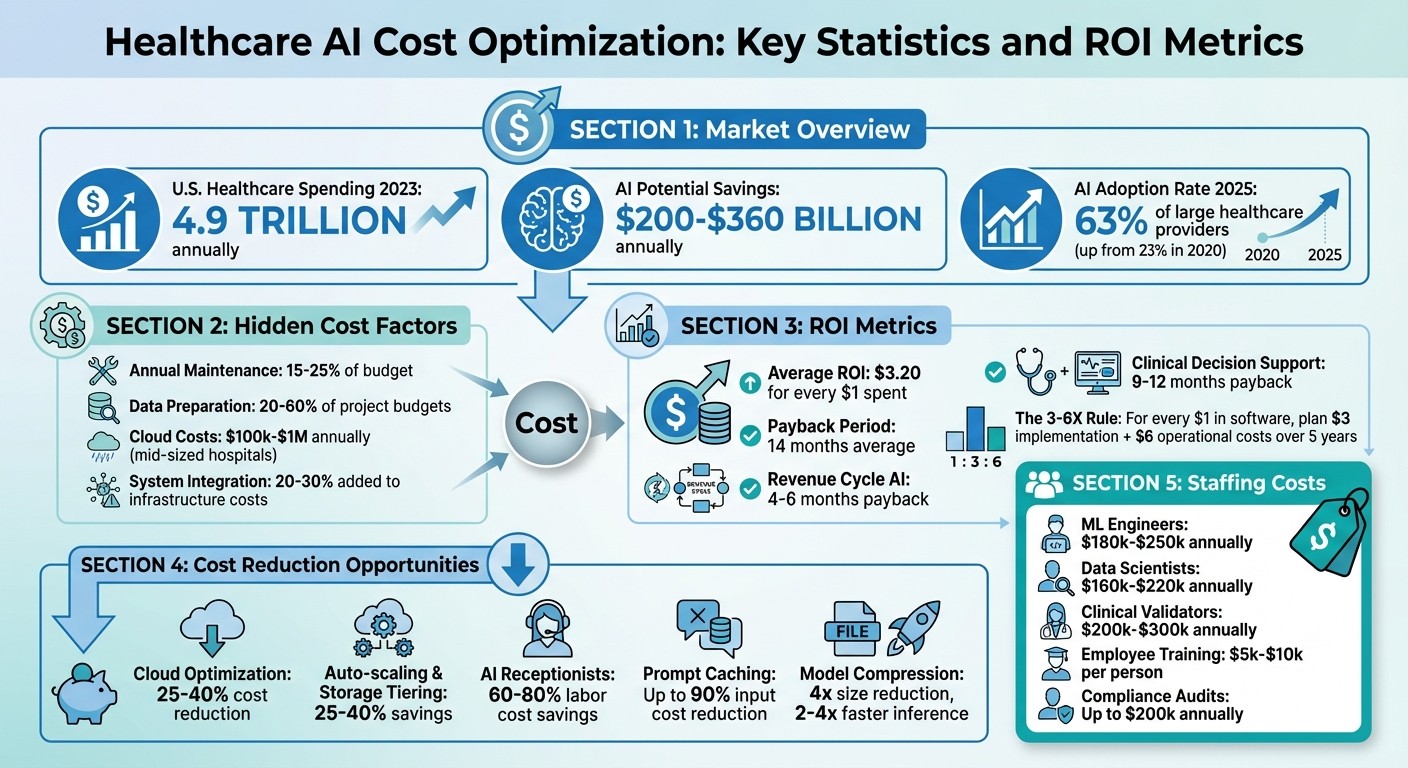
AI is transforming healthcare, but managing its costs is critical to avoid financial strain. U.S. healthcare spending hit $4.9 trillion in 2023, and while AI promises savings of $200–$360 billion annually, poor planning can lead to overspending. By 2025, 63% of large healthcare providers adopted AI, up from 23% in 2020. However, challenges like data preparation, system integration, and compliance can inflate costs.
Key takeaways for controlling AI expenses:
Hidden Costs: Maintenance, retraining, and cloud infrastructure can add 15–25% annually to budgets.
Data Prep: Cleaning and labeling data can consume 20–60% of project budgets.
Cloud Costs: Mid-sized hospitals spend $100k–$1M annually on cloud resources. Strategies like auto-scaling and storage tiering can cut costs by 25–40%.
ROI: Healthcare AI delivers $3.20 for every $1 spent, typically within 14 months.
Cost-effective solutions include automating admin tasks, optimizing cloud usage, and deploying smaller, efficient AI models. For example, AI-powered tools like Lead Receipt save up to 80% on labor costs while improving patient engagement. By focusing on strategic deployment and monitoring expenses, healthcare organizations can maximize AI’s benefits without overspending.
Healthcare AI Cost Optimization: Key Statistics and ROI Metrics
Measuring Your Current AI Spending and Returns
When tackling the cost challenges of healthcare AI projects, it’s critical to measure spending and returns accurately. Many organizations focus on upfront software costs but fail to account for the bigger picture. Here’s the reality: initial development is just a small piece of the puzzle. Over five years, operational expenses can outpace initial development costs by three to six times. This "3-6X Rule" means that for every $1 spent on AI software, you should plan for $3 in implementation costs and $6 for operational expenses over five years [9].
One of the biggest hurdles is tracking hidden costs. A prime example is data preparation, which often gets overlooked during budgeting but can consume significant resources [3][5]. Integration with existing systems like EHRs and billing platforms adds another 20% to 30% to infrastructure costs [5]. And then there’s staffing: salaries for machine learning engineers range from $180,000 to $250,000, data scientists make $160,000 to $220,000, and clinical validators can cost between $200,000 and $300,000 annually [9]. On top of that, training employees costs $5,000 to $10,000 per person [10], while compliance audits can run up to $200,000 a year [10]. Understanding these costs is crucial for calculating ROI and identifying areas where resources might be slipping through the cracks.
Calculating ROI for Healthcare AI Systems
Once you have a handle on your total costs, calculating ROI becomes the next step. The general formula is straightforward: (Annualized Benefits − Annualized Costs) ÷ Annualized Costs [11][12]. For healthcare AI, ROI usually falls into three categories:
Labor substitution: This measures the hours saved by automation and multiplies them by fully loaded rates, which include wages, recruiting, management, and quality assurance costs [11].
Throughput improvements: Faster revenue recognition is tracked by reducing days in accounts receivable (A/R). The formula is (Annual Revenue × A/R Days Reduced) ÷ 365[12].
Quality and risk reduction: This includes avoided claim denials and penalties. For instance, AI-powered revenue cycle management can cut denial rates by 40% and boost clean claim rates above 95%[13].
On average, healthcare AI investments return $3.20 for every $1 spent within 14 months. However, this payoff isn’t immediate. The first 1–4 months are often a quiet phase of building and testing. Returns gradually increase during pilot and growth phases before reaching steady-state benefits [13][10][14]. For example, revenue cycle AI typically delivers payback in 4–6 months, while clinical decision support systems take 9–12 months [9]. Establishing clear ROI metrics helps guide strategic decisions and ensures you're spending wisely.
To measure ROI effectively, start with baseline metrics. Track your current cost per claim, denial rates, days in A/R, and clean claim rates [12]. Without these benchmarks, proving ROI when questioned by executives becomes nearly impossible.
Finding What Drives Your AI Costs
After calculating ROI, it’s essential to break down the key cost drivers behind your AI spending. While the major expense categories are predictable, their proportions vary depending on the complexity of your AI system.
Cost Category | Percentage of Total Budget |
|---|---|
Data Preparation | 15–35% [14] |
System Integration | 10–30% [14] |
Annual Maintenance | |
Compliance & Security | 30–50% of original development cost annually [4] |
Cloud infrastructure is another area that requires close attention. Costs range widely, from $430 per month for basic AI tools to over $15,000 per month for training complex models [2]. Mid-sized hospitals often spend between $100,000 and $1 million annually on cloud services alone [4]. Without proper monitoring or auto-scaling, you could end up paying for idle resources during off-peak times.
Model drift is another hidden cost. As AI accuracy declines over time, retraining becomes necessary and can account for 25% to 45% of long-term expenses [8]. A smart way to manage this is by starting with a pilot program, which typically costs $8,000 to $15,000. This allows you to identify gaps in training, infrastructure, or adoption without committing your entire budget upfront [10][8]. By understanding these cost drivers, you can create a long-term plan to align your AI investments with your organization’s goals and avoid unnecessary spending.
How to Reduce AI Infrastructure Expenses
Once you've pinpointed the main drivers of AI costs, the next step is figuring out how to cut expenses without sacrificing performance. In healthcare, overspending often stems from overprovisioned resources, inefficient model deployment, and poorly optimized data workflows. A focused cost-reduction strategy can lead to a 25% to 40% decrease in total spending within 6–12 months [18]. The trick is to apply targeted measures across cloud infrastructure, model operations, and data management.
Managing Cloud Resources to Lower Costs
Cloud spending is one of the easiest areas to trim because many healthcare organizations overprovision resources during initial migrations [16][17]. Start by rightsizing resources, which can save 15% to 30% on compute costs. For predictable, always-on workloads, consider Savings Plans or Reserved Instances, which can offer discounts of up to 72% [16].
For non-critical tasks, use Spot Instances and set up checkpointing every 15–30 minutes to minimize the impact of interruptions. Dynamic autoscaling is another effective tool - healthcare traffic often dips during nighttime hours, so scaling down resources during these periods helps avoid paying for idle capacity [16][19].
Switching to specialized hardware can also make a big difference. AI-specific chips like AWS Trainium or Google TPUs, as well as ARM-based processors like AWS Graviton, provide a 40% better price-to-performance ratio for healthcare workloads [16]. Additionally, deploying workloads in lower-cost cloud regions - like Mumbai or São Paulo - can reduce compute expenses, as long as data residency and compliance requirements are met [15][18]. For storage, implement tiered storage solutions. Moving rarely accessed data, such as old patient records, to low-cost archival tiers like Amazon S3 Glacier can save 50% to 80% on storage costs [16].
"Healthcare teams must embrace this mindset and have access to tools to continuously monitor performance and associated costs." - Allyson Fryhoff, Managing Director of Global Healthcare and Life Sciences, AWS [19]
Automated tools can also help. They can identify idle instances, orphaned storage volumes, or untagged resources left running after a project ends [19]. Keeping AI processing within the same cloud region as your data source avoids expensive inter-region egress fees [15].
These optimizations set the stage for more cost-effective AI model deployments, which we’ll explore next.
Building and Deploying AI Models Efficiently
Beyond managing cloud resources, how you build and deploy models can significantly impact costs. Start by choosing the smallest model that meets clinical quality requirements - this alone can cut costs by up to 45% [25]. For example, use compact models like GPT-4o-mini or Claude Haiku for routine tasks, reserving high-parameter models for complex clinical reasoning [18][21].
Compression techniques like pruning, quantization, and knowledge distillation can also help. For instance, quantizing a model from 32-bit to 8-bit reduces its size by 4x and speeds up inference by 2x to 4x [26][18]. When fine-tuning, opt for Parameter-Efficient Fine-Tuning (PEFT) methods like LoRA, which update less than 1% of parameters. This approach can slash training time, GPU memory requirements, and costs by over 90% compared to full fine-tuning [26].
To save on training costs, consider Managed Spot Training, which can reduce expenses by up to 90% compared to On-Demand instances [25]. Checkpointing ensures progress isn’t lost if an instance is reclaimed. For inference, use Model Cascades - a smaller, faster model handles simple tasks, while more complex cases are passed to expensive models. This prevents overspending on tasks that don’t require premium AI capabilities.
GPU utilization often sits at 30–50%, leading to unnecessary waste [27]. Automate idle shutdowns by setting development instances to terminate after 30–60 minutes of low GPU usage. Also, profile workloads to match them with the right hardware. For models under 7 billion parameters, cheaper GPUs like the RTX 4090 or L4 often provide better cost-per-token than high-end options like H100s [27].
Improving Data Workflows to Cut Costs
Data preparation and management in healthcare AI deployments can cost anywhere between $50,000 and $250,000 [8]. Streamlining these workflows can lead to significant savings without sacrificing performance. Start by automating preprocessing to clean and format raw data efficiently, which cuts down on unnecessary compute costs from processing "noisy" data [20].
Balance real-time and batch processing based on urgency. Reserve real-time processing for critical clinical data and handle less urgent administrative tasks in batches, which can save 15% to 30% on eligible workloads [20][18]. For high-volume operations, switch from automation platforms like Zapier or Make to direct API calls, reducing costs by 70% to 90% by avoiding platform markups [23].
Implement multi-layer caching to reduce redundant processing. For instance, prompt caching can cut input token costs by up to 90% [24]. Semantic caching goes a step further by storing responses for semantically similar queries, achieving a 73% cost reduction with hit rates around 67% [24]. For patient-facing chatbots, this means storing answers to common questions like "How do I prep for a colonoscopy?" to avoid repeated processing by large language models [18][21].
Prompt compression is another effective strategy. Techniques like LLMLingua can compress prompts up to 20x with minimal accuracy loss (about 1.5%) [24]. Summarizing past patient conversations and removing irrelevant metadata from inputs keeps the model focused and reduces token billing [21]. Also, set max_tokens limits to prevent verbose outputs and use healthcare-specific prompt templates for efficiency [21].
For Retrieval-Augmented Generation (RAG) systems, optimize by using hybrid search (combining keyword and vector search) and rerankers to surface only the most relevant "top-k" evidence chunks. This reduces token bloat and improves the relevance of responses [22][24]. Additionally, feature stores allow you to manage and reuse datasets across multiple projects, eliminating redundant data engineering efforts [17]. To maintain data freshness while maximizing cost savings, set TTL (Time-to-Live) for cached data based on how often clinical data or source indexes are updated [18][22].
AI Applications That Deliver the Best Returns in Healthcare
AI's impact in healthcare can vary, but the most effective applications are those that reduce costs while improving operational workflows. Many AI tools can pay for themselves in as little as three to six months, freeing up staff to focus on more critical clinical tasks. By prioritizing cost reduction and efficiency, these AI solutions transform healthcare operations and enhance patient interactions.
Automating Office and Administrative Tasks
Administrative automation is one of the fastest ways to see returns from AI in healthcare. Medical practices, on average, miss 42% of calls during business hours, with each missed call potentially costing between $200 and $500 in lost revenue [28]. AI receptionists step in to handle tasks like answering calls, scheduling appointments, and verifying insurance 24/7 - ensuring no opportunities are missed.
The cost difference is striking. While a human receptionist costs around $58,000 annually (including salary and benefits), AI systems typically range from $5,000 to $10,000 per year, cutting labor costs by 60% to 80% [38,39]. These AI tools also achieve over 98% scheduling accuracy and respond to inquiries in under 30 minutes - far quicker than the average 3-hour response time from human staff [32,33].
AI doesn't just stop at call management. Tools like AI scribes create clinical documentation during patient visits, saving time for physicians [29]. Automated patient intake systems streamline registration, identity verification, and consent processes, reducing wait times and easing the workload for front-desk staff [34,35]. Many of these systems also support over 100 languages, including American Sign Language, making healthcare more accessible for diverse populations. A hybrid approach - where AI handles 70% to 80% of routine tasks while humans address complex or sensitive needs - delivers efficiency without losing the personal touch [33,34].
Using Predictive Analytics to Allocate Resources Better
Predictive analytics play a key role in cutting waste and improving resource allocation. For example, UnityPoint Health's "Readmission Heat Map" AI tool saved $32.2 million over 30 months while reducing avoidable admissions by 54.4% [30]. Similarly, Johns Hopkins used predictive models to save $4 million annually and cut readmissions by 20% [30].
Health System | AI Solution | Financial Impact | Outcome |
|---|---|---|---|
UnityPoint Health | Readmission Heat Map | $32.2M Savings | 54.4% Admission Reduction |
ZSFG | Epic Readmission Risk V2 | $7.2M Retained | 4-Point Readmission Drop |
$4.6M Savings | 2.1-Point Readmission Drop | ||
Johns Hopkins | Predictive Risk Models | $4M Annual Savings | 20% Readmission Reduction |
Predictive AI also improves bed and flow management by identifying patients likely to experience prolonged stays or delayed discharges, reducing bottlenecks and the need for extra case managers [30]. In surgical scheduling, AI can optimize operating room usage, freeing up time for at least two additional procedures per month per room - boosting revenue without requiring additional infrastructure [30]. Predictive tools also help flag potential insurance coverage issues and identify at-risk accounts, allowing proactive measures to minimize revenue loss [1].
Improving Patient Communication and Appointment Booking
Clear and consistent communication with patients is essential for retention. Practices that fail to reach patients on the first attempt risk losing up to 67% of those considering switching providers [28]. AI-powered systems ensure that patient inquiries are never missed, capturing 97% to 100% of incoming calls - even outside of regular business hours [33,40].
Take Lead Receipt's AI receptionists, for instance. These systems handle voice and chat interactions 24/7, managing appointments, inquiries, and routing complex questions. The Professional plan, priced at $750 per month, includes a dedicated line supporting five languages, call recordings, lead data output, and priority support for up to 100 AI calls daily. For larger needs, the Enterprise plan offers unlimited calls, customizable automation, and a dedicated AI consultant.
When comparing costs, an AI receptionist (costing $5,000 to $10,000 annually) is far more economical than a human receptionist's $58,000 annual expense. This cost difference results in a payback period of just three to six months [31]. The Starter plan ($300 per month) covers 24/7 web-chat support for digital intake, while higher-tier plans integrate voice capabilities and connect seamlessly with EHR systems like Epic, Cerner, and athenahealth using FHIR standards [33,35]. With an accuracy rate of 99.7%, these systems handle routine tasks efficiently, allowing human staff to focus on more complex and emotionally sensitive issues. These AI tools not only optimize costs but also enhance patient care and satisfaction.
Lead Receipt's Pricing and Features for Healthcare
Lead Receipt Plans: Starter, Professional, and Enterprise
Lead Receipt offers three subscription options tailored to different needs in the healthcare industry:
Starter Plan: At $300 per month, this plan includes 24/7 web-chat support, AI-powered visitor responses, standard analytics, and email support. It's designed for smaller practices prioritizing digital intake.
Professional Plan: Priced at $750 per month, this plan builds on the Starter features by adding voice capabilities. It supports up to 100 AI-driven calls per day in five languages, provides a dedicated phone line, call recordings, lead data export, and priority support. It's a great fit for practices managing moderate call volumes.
Enterprise Plan: Custom-priced for larger healthcare organizations, this plan offers unlimited calls, fully customizable automation, dedicated AI consulting, and enterprise-grade compliance features. It's ideal for businesses with extensive operational needs.
Here’s a quick breakdown of the plans:
Plan | Monthly Cost | Best For | Key Features |
|---|---|---|---|
Starter | $300 | Small practices needing digital intake | 24/7 web-chat, AI visitor answers, standard analytics, up to 3 domains |
Professional | $750 | Moderate call volume practices | 24/7 voice/chat, 5 languages, lead export, call recordings, 100 calls/day |
Enterprise | Custom | Large organizations with high demand | Unlimited calls, custom automation, dedicated consultant, unlimited integrations |
How Lead Receipt Helps Healthcare Businesses Save Money
By adopting Lead Receipt's AI-powered solutions, healthcare providers can significantly reduce operational costs. Consider this: a human receptionist costs about $38,240 annually, while Lead Receipt's Professional plan costs approximately $9,000 per year. Not only does this AI solution operate 24/7, but it also manages multiple calls at once and automates repetitive tasks, offering a clear cost advantage.
Tasks like logging client details, routing urgent calls, and sending scheduling updates are seamlessly automated. This integration with existing healthcare systems minimizes manual errors and allows staff to focus on patient care. These efficiencies align with broader cost-saving strategies, ensuring that investments in AI yield measurable results.
Additionally, statistics show that 67% of customers do not leave a voicemail when their call is missed, often opting to contact a competitor instead [32]. Lead Receipt’s 24/7 availability ensures every patient inquiry is captured, maintaining revenue and enhancing engagement. This round-the-clock reliability demonstrates how AI solutions can streamline operations and support growth in the healthcare sector.
Creating a Long-Term AI Cost Management Plan
Defining Your AI Cost and Performance Goals
Establishing clear goals for AI systems means going beyond generic efficiency claims to set specific, measurable targets. One effective method is activity-based costing, which assigns actual expenses to individual activities - like operating room time or supply usage - instead of relying on broad departmental averages. This granular approach highlights areas where clinical variations may be driving unnecessary costs.
ROI timelines for AI projects can differ significantly based on the use case. For example, administrative tasks like claims denial prevention often yield returns in under a year, while initiatives like discharge planning may take over a year to show results[34]. A real-world example comes from Health Catalyst's orthopedic team, which used AI-driven activity-based costing to identify inconsistencies in hip and knee replacement protocols. By standardizing these clinical pathways, they saved $815,103 over two years (2023–2025)[33].
Incorporating model routing into your strategy can also optimize costs. Assign simpler tasks, like classification, to lightweight models, and reserve advanced models for more complex operations[7]. This method can slash token costs by up to 100x for routine functions. As Kathleen Merkley, Senior Vice President of Professional Services at Health Catalyst, explains:
"Physicians want to know that the numbers reflect what actually happened. They need to see their actual cases, not generalized reports"[33].
AI Use Case | Expected ROI Impact Time | Primary Economic Benefit |
|---|---|---|
Claims Denial Prevention | < 1 Year | Reduced revenue leakage/improved coding |
OR & Procedure Optimization | < 1 Year | Improved resource allocation/staff satisfaction |
Supply Chain Management | < 1 Year | Accurate cost-variance/inventory intelligence |
Discharge Planning | > 1 Year | Reduced length of stay/readmission risk |
Sepsis Detection | < 1 Year |
Tracking AI Expenses Over Time
Once goals are in place, carefully tracking expenses is essential for maintaining financial discipline and achieving long-term success.
Start with centralized data collection. Automate the retrieval of billing data from providers like OpenAI, Anthropic, and AWS into a unified dashboard. This eliminates fragmented visibility across platforms[37]. Use a robust tagging system to categorize AI-related expenses by project, department, or model, ensuring accountability[36].
Instead of only focusing on total spending, track unit economics - such as the cost per patient query or medical image analyzed. This ties expenses directly to business outcomes[37]. Set proactive budget alerts that notify you when daily spending exceeds limits or when monthly budgets hit 50%, 75%, and 90% thresholds[37]. These alerts can help prevent budget overruns.
Regularly monitor model performance to address issues like data drift, which can lead to costly retraining. Data preparation alone can account for 20%–40% of AI implementation costs, while ongoing maintenance typically represents 20%–30% of the initial investment annually[3][6]. Understanding these cost patterns helps forecast future expenses. As the Cake Team puts it:
"True AI cost management is not about spending less; it's about spending smarter. It's a strategic practice focused on maximizing the value and ROI of every dollar you invest in your AI stack"[36].
Metric | Why it Matters |
|---|---|
Total Daily Spend | Tracks sudden spikes or gradual increases in costs[37] |
Spend by Model | Identifies cost drivers and areas for optimization[37] |
Resource Utilization | Highlights underused GPUs/CPUs, signaling over-provisioning[36] |
Budget Variance | Flags discrepancies between forecasted and actual spend[36] |
Cost per Transaction | Links AI costs to specific clinical or business outcomes[36] |
Designing AI Systems That Grow With Your Business
A long-term AI cost management plan isn't complete without scalable systems that adapt as your business evolves.
Start with intelligent model tiering. Match models to task complexity - use lightweight options, like Claude 3 Haiku, for simpler tasks, and reserve premium models, such as GPT-4o, for complex reasoning[24][23]. Employ a "cascade" system where tasks are first routed to the most cost-effective model, escalating to more advanced options only when necessary[24].
Dynamic auto-scaling is another essential feature. It allows compute resources to ramp up during peak demand and scale down during idle times, reducing unnecessary costs[36][18]. For high-volume but non-urgent tasks, like clinical documentation, use Batch APIs to secure discounts of up to 50%[18][24]. For example, Skywork.ai cut its monthly AI costs by 66% - from $3,200 to $1,100 - using a three-tier model architecture in 2025–2026[24].
Ensure seamless integration with existing healthcare IT systems, like Epic or Cerner, by using standard protocols such as HL7/FHIR. This avoids costly custom middleware down the road[4][3]. Additionally, implement prompt and semantic caching to reduce input costs by up to 90% for frequently used prompts[37][24]. Fine-tuning smaller models (7B–14B parameters) can also achieve performance comparable to larger models at a fraction of the cost[24]. Stanford University's FrugalGPT research demonstrated that cascading queries to less expensive models first could reduce costs by up to 98% without sacrificing accuracy[24].
Tagging expenses by project, team, or department ensures precise ROI tracking. Also, review platform seat licenses monthly to remove inactive users, saving 15%–30% on per-seat costs[36][18]. As Pertama Partners notes:
"Most organizations overspend on AI not because models are inherently expensive, but because licenses, architecture, and usage patterns are left unoptimized"[18].
These strategies provide a robust framework for managing AI costs effectively while maximizing long-term value in healthcare.
Summary: Main Points for Managing AI Costs in Healthcare
Managing AI costs in healthcare requires focusing on efficient use cases, simplifying data workflows, and implementing scalable solutions. Start with high-impact, low-complexity applications, such as appointment triage or patient follow-ups, before tackling more advanced clinical models. Administrative AI solutions generally involve lower upfront costs compared to complex clinical models, making them a practical entry point[8][5]. These initial steps can help address hidden costs like data preparation and integration.
Data preparation is often one of the largest cost factors[5][2]. Investing early in tools like automated labeling or synthetic data generation can help reduce these expenses. Similarly, opting for cloud-based systems instead of on-premise setups can lower capital expenses while offering better scalability. However, integrating cloud solutions with existing EHR/EMR systems may raise infrastructure costs by 20–30%[5][8].
The financial benefits of healthcare AI are compelling. On average, healthcare AI achieves an ROI of $3.20 for every $1 spent[8][2]. Most organizations see returns within 14 months of implementation, highlighting the value of phased rollouts and pilot programs[8]. These strategies emphasize the importance of scalable and cost-effective AI investments.
For organizations looking for affordable AI solutions, Lead Receipt offers flexible pricing plans tailored to different needs. The Starter plan, priced at $300 per month, includes 24/7 web-chat support. The Professional plan, at $750 per month, adds AI voice and chat capabilities for up to 100 daily calls. The Enterprise plan provides fully customizable automation with unlimited calls. This tiered structure allows businesses to start small and scale up as they achieve measurable ROI[8][5].
To maintain long-term cost control, tracking financial metrics like cost per transaction, resource utilization, and budget variance is crucial. Allocate 20–30% of the initial investment annually for ongoing maintenance, including system upgrades and retraining, to ensure sustained performance and efficiency.
FAQs
What costs do healthcare teams often overlook when budgeting for AI?
When healthcare teams budget for AI, they often overlook several expenses that can add up quickly. For instance, ongoing maintenance and system integration are frequently underestimated. Similarly, staff training - a crucial step for successful AI adoption - can be more costly than expected.
Another area that tends to be missed is the cost of preparing data. This includes tasks like cleaning, securing, and organizing data to meet the necessary standards. On top of that, ensuring regulatory compliance can be a significant expense, especially in healthcare, where data privacy and security laws are strict.
Infrastructure costs are another blind spot. Expenses for cloud services, hardware upgrades, or both can strain budgets. Finally, many teams fail to fully account for the need for consulting services or customization to tailor AI systems to their specific needs, which can leave them facing unanticipated budget gaps.
How do I measure AI ROI if our benefits are spread across multiple departments?
To evaluate AI ROI across different departments, start by establishing specific KPIs tailored to each area. These could include cost savings, efficiency improvements, or revenue increases. Once you’ve gathered these metrics, combine them into a single ROI formula:
(Total benefits − Total costs) ÷ Total costs.
It’s essential to monitor these results consistently and compare them against benchmarks. This approach ensures accuracy in your measurements and helps you clearly communicate the value of AI initiatives to stakeholders.
What’s the fastest way to cut cloud and token costs without reducing AI quality?
To cut down on cloud and token expenses without compromising AI performance, prioritize model routing and workload segmentation. This means assigning simpler tasks to lower-cost models while saving the more advanced models for complex operations. On top of that, techniques like prompt caching and prompt engineering - such as shortening prompts or reusing cached inputs - can significantly reduce token usage. These approaches allow for smarter spending while keeping performance levels high.