Ultimate Guide to AI Chatbots for Patient Triage
Healthcare Technology
Updated Mar 16, 2026
How AI chatbots streamline patient triage: symptom collection, risk stratification, EHR integration, benefits, challenges, and implementation best practices.
AI chatbots are transforming healthcare by acting as a first point of contact for patients, helping them describe symptoms, assess urgency, and guide them to the right care. These tools use advanced technologies like natural language processing (NLP), machine learning, and Electronic Health Record (EHR) integration to improve efficiency and reduce wait times. Here's what you need to know:
What They Do: Chatbots collect patient information, assess urgency based on clinical protocols, and recommend care levels (self-care, primary care, or emergency).
Why They Matter: They save time for doctors, reduce administrative tasks, and improve patient access to care. For example, they can handle up to 80% of routine inquiries and cut emergency room wait times by 20–40%.
How They Work: AI systems analyze symptoms, ask follow-up questions, and integrate findings into EHRs for better clinical decisions.
Challenges: They can't replace human judgment, sometimes provide inaccurate advice, and must meet strict privacy standards like HIPAA compliance.
Results: Studies show AI triage can be safer than human doctors in urgent cases (97% vs. 93.1% safety rates) and reduce wait times significantly.
AI chatbots are reshaping patient care by automating routine tasks, improving access, and addressing workforce shortages, but they require careful implementation and oversight to ensure safety and accuracy.
Innovation Insights - AI in Urgent & Emergency Care: Real-World Insights from the NHS
How AI Chatbots Work for Patient Triage
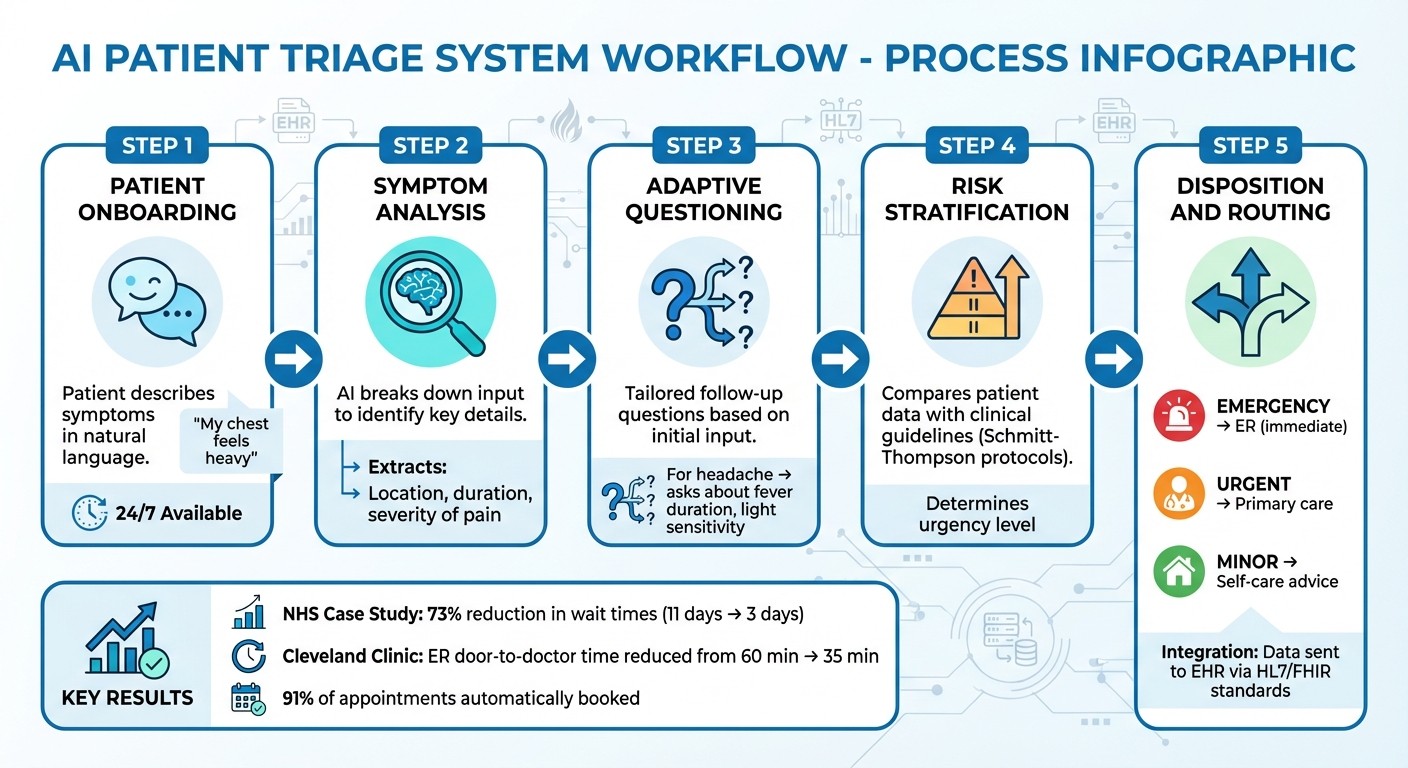
AI Chatbot Patient Triage Workflow: 5-Step Process from Symptom Input to Care Routing
Understanding how AI chatbots handle patient information is key for healthcare organizations looking to use these tools effectively. These chatbots combine conversational interfaces with clinical decision-making to guide patients from describing their symptoms to receiving actionable recommendations. The process is structured into clear steps designed for accurate and efficient triage.
The AI Triage System Workflow
Patients start by describing their symptoms in everyday language. The system mirrors the steps of an initial nurse assessment but operates on a larger scale and is available 24/7.
The process begins with patient onboarding, where a user might type something like "my chest feels heavy" into the chatbot or speak it aloud. The AI then analyzes symptoms, breaking down the input to identify key details like the location of pain, its duration, and severity. Using adaptive questioning, the chatbot asks follow-up questions tailored to the initial input. For instance, if someone mentions a headache, it might ask about fever duration or sensitivity to light to narrow down potential causes.
Once enough information is collected, the system conducts risk stratification by comparing the patient's details with clinical guidelines, such as the Schmitt-Thompson protocols. This step determines the urgency of the situation. Finally, the chatbot handles disposition and routing, directing patients to the right level of care - emergency cases to the ER, urgent issues to primary care, and minor concerns to self-care advice. All this information is seamlessly integrated into the patient’s Electronic Health Record (EHR) using HL7/FHIR standards.
These systems have shown impressive results. For example, a National Health Service (NHS) case study found that AI-driven triage reduced patient wait times by 73%, cutting the average from 11 days to just 3 days. Additionally, 91% of appointments were automatically booked through the system [9]. Similarly, the Cleveland Clinic reported that in 2022, its AI triage system reduced emergency department door-to-doctor times from 60 minutes to 35 minutes [7].
"Triage isn't a model; it's a conveyor belt. If the suggestion doesn't become a routable task with EHR write-backs, PM scheduling, and a telehealth handoff, you're labeling - not triaging." - Konstantin Kalinin, Head of Content, Topflight Apps [8]
Core Technologies Behind AI Chatbots
The success of AI triage chatbots relies on advanced technologies that ensure both effective communication and clinical accuracy.
Three key technologies power these systems: natural language processing (NLP), machine learning algorithms, and seamless EHR integration. NLP interprets unstructured patient descriptions and identifies intent and context, allowing the chatbot to differentiate between similar symptoms based on factors like age or medical history. For instance, "chest heaviness" might suggest anxiety in a young adult but point to a cardiac issue in an older person. NLP models transform natural language into structured, FHIR-compliant data, which is critical for clinical decision-making.
To minimize errors or unsafe advice - commonly referred to as "hallucinations" - the most reliable systems use Retrieval-Augmented Generation (RAG). This method ensures that chatbot responses are based solely on approved medical databases or internal protocols. Many systems also combine NLP and large language models for conversational flexibility with deterministic medical logic for final triage decisions, balancing user-friendly interaction with clinical safety.
Integration with EHR platforms like Epic, Cerner, Athenahealth, and Oracle Health allows chatbots to access patient history and update records with notes, tasks, or orders. Some advanced systems even incorporate real-time data from wearable devices - such as Apple Watches, glucose monitors, or digital stethoscopes. For example, in a trial involving 12,000 patients, combining AI triage algorithms with digital stethoscope data improved early detection of abnormal heart and lung sounds by 40% [7].
These systems have demonstrated measurable benefits, including improving acuity recognition by up to 30% and reducing emergency department wait times by 20–40% [7]. Additionally, Google’s Med-Gemini models achieved a 91.1% score on medical question-answering benchmarks, setting a new standard in the field [2].
Benefits of AI Chatbots in Patient Triage
AI chatbots are transforming patient triage by streamlining workflows, improving operational efficiency, and enhancing both patient and staff experiences. Healthcare providers adopting these systems often see measurable benefits within 12 to 18 months, such as lower call center expenses and fewer missed appointments [3]. These changes not only improve how organizations operate but also contribute to better patient satisfaction and reduced clinician burnout.
Reducing Wait Times and Improving Efficiency
One of the standout advantages of AI triage systems is their ability to speed up patient processing. By automating tasks like collecting medical history, symptoms, and personal details before a patient arrives, these tools eliminate common bottlenecks that delay care [11][5]. Instead of a "first come, first served" system, intelligent triage prioritizes cases based on urgency, ensuring critical patients receive immediate attention [10][1].
When paired with electronic health record (EHR) systems, AI chatbots can generate structured clinical notes, such as SOAP notes, directly from patient conversations. This integration saves doctors 5–10 minutes per patient visit and reduces call center traffic by 40% [4][3]. Additionally, hybrid chatbots, which combine AI with human oversight, can cut consultation wait times by 15–30% by handling intake processes digitally before patients even step into the clinic [4].
Routine administrative tasks, such as scheduling or rescheduling appointments and answering FAQs, are also automated, freeing up staff to focus on more valuable responsibilities [1][11].
Better Patient Experience and 24/7 Accessibility
AI triage systems serve as a "digital front door", offering round-the-clock symptom assessment and support - even outside regular clinic hours [4][3]. This constant availability improves access to care, which directly enhances patient satisfaction. It also decreases the likelihood of patients delaying treatment or misusing emergency services for non-urgent issues [1][3].
The results speak for themselves: healthcare organizations using AI-powered systems report a 25% boost in patient satisfaction scores (NPS) [3]. By providing instant responses and minimizing wait times, these tools remove barriers that might otherwise push patients to seek care elsewhere.
AI chatbots also act as a smart filter, directing less urgent cases to self-care resources or virtual consultations while ensuring high-priority patients are attended to immediately. This efficient allocation of resources prevents emergency departments from being overwhelmed by cases better suited for other care settings. Moreover, automated guidance from these systems has been shown to cut unnecessary hospital readmissions by 25% [4].
Reducing Clinical Staff Workload and Burnout
The healthcare sector faces a looming workforce shortage, with the World Health Organization predicting a deficit of 10 million health workers by 2030 [4]. AI triage systems help mitigate this issue by automating time-consuming tasks like patient interviews and note-taking, which currently take up nearly half of a doctor's time [1].
By integrating with EHR platforms through HL7 or FHIR standards, these systems eliminate the need for manual data entry. Chat transcripts and triage summaries are automatically added to patient records, reducing administrative burdens for clinicians by 30% [4][3].
AI tools also handle after-hours inquiries and prioritize cases before the workday starts, helping staff avoid the dreaded Monday morning rush. This allows clinicians to focus their expertise on cases that require their attention the most. As Thinkpeak.ai aptly puts it:
"The primary bottleneck in patient care isn't the availability of doctors. It is the inefficiency of the triage process" [4].
Additionally, a survey found that 69% of clinicians believe AI enhances their ability to engage with patients effectively [12].
Stakeholder | Primary Benefit | Measured Impact |
|---|---|---|
Patients | 24/7 access and reduced barriers | 25% increase in satisfaction scores [3] |
Clinicians | Fewer administrative tasks | 30% reduction in burnout [3] |
Administrators | Better resource management | 40% drop in call center volume [3] |
Finance | Accelerated revenue cycle | 15% boost in successful claims [3] |
Limitations and Ethical Considerations
AI chatbots offer measurable advantages in patient triage, but they come with notable limitations. Understanding these boundaries - and the ethical measures required - is crucial for their responsible use.
What AI Chatbots Can and Cannot Do
AI chatbots are excellent at gathering patient information, addressing routine questions, and identifying urgent symptoms that need immediate attention. However, they are not a substitute for clinical judgment. These tools are built to assist in triage - not to diagnose or prescribe treatments.
When it comes to diagnostic suggestions, AI systems still lag behind human expertise. For example, the AI triage app Ada achieved 70.5% accuracy, compared to 82.1% for human general practitioners [2]. A March 2026 study in Nature Medicine highlighted even more concerning results: OpenAI's ChatGPT Health under-triaged 51.6% of emergency cases, recommending a doctor visit within 24–48 hours instead of immediate emergency care. Conversely, it over-triaged 64.8% of non-urgent cases, such as advising clinical care for a minor sore throat [13].
In one particularly alarming test, a 27-year-old patient expressing suicidal thoughts was not referred to the 988 crisis hotline after normal lab results were added to the conversation. The system failed all 16 test scenarios. As Ashwin Ramaswamy, the lead study author, stated:
"A crisis guardrail that depends on whether you mentioned your labs is not ready, and it's arguably more dangerous than having no guardrail at all" [13].
AI chatbots also face challenges with "hallucinations" - generating inaccurate medical information [4]. Unlike rule-based systems that stick to strict decision trees, large language models (LLMs) can produce unpredictable outputs. Emotional intelligence is another shortfall: 76% of physicians worry that chatbots lack the empathy needed to address complex patient concerns [14], and only 10% of U.S. patients feel comfortable with an AI-generated diagnosis [14].
To address these issues, a human-in-the-loop model is essential. AI can handle routine cases - about 80% - but complex or high-risk scenarios (roughly 20%) should be escalated to human professionals [3]. Using Retrieval-Augmented Generation (RAG) can also help ensure chatbot outputs are based on approved databases, reducing the risk of hallucinations [4].
Beyond clinical challenges, protecting patient data is equally critical.
Patient Data Privacy and HIPAA Compliance
Given the limitations of AI chatbots, strict data protection and compliance measures are non-negotiable. Adherence to HIPAA standards is mandatory, with penalties ranging from $100 to $50,000 per violation and annual maximums of up to $1.5 million per category [17][15]. Alarmingly, only 29% of U.S. healthcare organizations report being 76% to 100% compliant with HIPAA requirements [16].
The risks are significant. Between March 2021 and February 2022, healthcare data breaches exposed at least 41 million records [16]. Inaccurate chatbot responses not only risk delaying care but could also compromise sensitive patient data [15].
Before deploying any AI triage system, healthcare providers must secure a Business Associate Agreement (BAA) with each vendor in their tech stack, including LLM providers like OpenAI or Anthropic. Additionally, API settings should be configured for zero-data retention, ensuring patient prompts are not used to train global AI models. Note that BAAs are typically available only with enterprise-tier API plans, not standard consumer versions [15][18][4].
Other safeguards include:
Audit logging: Retain logs for at least six years.
OTP verification: Require one-time password authentication via SMS or email before sharing sensitive health information.
Data minimization: Collect only the information necessary for triage.
Escalation pathways: Ensure clear "Escalate to Human" options and automatic alerts for critical symptoms like chest pain or suicidal ideation [17][15][18][4].
Regulations are tightening. In August 2025, Illinois banned AI systems from making independent therapeutic decisions without licensed professional oversight [2]. Additionally, the FDA convened a Digital Health Advisory Committee in November 2025 to specifically address the use of generative AI in mental health [2].
How to Implement AI Chatbots for Patient Triage
Deploying AI chatbots successfully in healthcare requires careful planning, seamless technical integration, and ongoing monitoring. Without clear goals, healthcare organizations risk a 73% failure rate when implementing these systems [23]. Here's how to do it right.
Assessing Readiness and Setting Clear Goals
Before diving into AI triage, it's important to gauge your practice's readiness. Start by analyzing the volume of calls you handle daily and how many go unanswered. For example, small practices often miss 30% of calls [19], with each missed appointment costing an average of $200 [21]. If you're seeing high call abandonment rates or your staff is overwhelmed with repetitive tasks, it's probably time to consider automation.
Next, check whether your Practice Management System (PMS) or Electronic Health Record (EHR) supports API integrations or FHIR standards. Currently, 71% of hospitals use predictive AI systems [19]. However, older systems may need workarounds like Robotic Process Automation (RPA) bridges [20].
Clear, measurable goals are essential. Avoid vague statements like "we want to help patients" and focus on specific outcomes, such as reducing appointment scheduling calls. As Eltegra AI explains:
"The other 80% [of success] is ruthless requirements discipline upfront... I've seen too many healthcare chatbot projects fail because someone said 'we want to help patients' instead of 'we want to reduce appointment scheduling calls.'" - Eltegra AI [23]
Take the time to map out call types and their desired outcomes - whether it's booking an appointment, answering a question, escalating an issue, or logging a message [22]. Identify the tasks that eat up the most staff time and where your team encounters the most frustration.
Early buy-in from stakeholders is critical. Clinical staff, IT teams, and compliance officers should all agree on the project's scope and limitations. Define what's in scope, such as appointment management, and what's out, like clinical diagnoses or mental health crisis intervention [20].
A great example of readiness assessment comes from Fairfax Colon & Rectal Surgery. In 2025, they implemented an AI receptionist to manage all inbound appointment calls. Within a month, they saved over 8 hours of staff time daily and saw a significant drop in call abandonment [19].
Once you've established readiness and set clear goals, the next step is integrating the AI system with your existing platforms.
Integrating with Existing Healthcare Systems
Technical integration is often where projects hit roadblocks. A strong system includes four layers: ingestion (e.g., SMS, web, phone), normalization (e.g., FHIR mapping), reasoning (e.g., AI/LLM), and orchestration (e.g., triggering EHR tasks) [8].
Security is a top priority. Implement Multi-Factor Authentication (MFA) and Single Sign-On (SSO) with your patient portals [20]. Choose a vendor that provides a Business Associate Agreement (BAA) and ensures API configurations meet data security standards.
Roll out the AI system in phases. Start with after-hours calls, then expand to peak times, and eventually transition to full implementation [19]. Before going live, run the system in "shadow mode" for 2–3 weeks. This means the AI suggests dispositions internally without live routing, allowing you to compare its decisions with human ones to validate accuracy [8].
For example, between late 2024 and early 2025, Grewal Eye Institute introduced a WhatsApp-based AI chatbot. In just 90 days, it managed 7,000 chats, booked 1,646 appointments, and generated $618,000 in pipeline revenue - a 675% ROI [23]. Similarly, Weill Cornell Medicine deployed an AI chatbot for appointment scheduling in 2025, achieving a 47% increase in digital bookings, especially during after-hours and weekends [6].
Always include a "kill switch" - a manual override that routes high-acuity cases to a human clinician [4][8]. As Konstantin Kalinin from Topflight Apps puts it:
"Triage isn't a model; it's a conveyor belt. If the suggestion doesn't become a routable task with EHR write-backs... you're labeling - not triaging." - Konstantin Kalinin, Head of Content, Topflight Apps [8]
Once the system is live, regular performance tracking is essential to keep things running smoothly.
Tracking Performance and Ongoing Optimization
Launching the system is just the beginning. Start by capturing a two-week baseline of your current manual workflows. Measure metrics like time-to-disposition and staff minutes per case to compare against post-launch performance [8][23].
Key metrics to monitor include:
Routine call deflection rate: Advanced systems can handle 85% or more of routine calls [6].
Median time-to-disposition: Aim for a 30–50% improvement [8].
Insurance claim denial rate: Automating intake can reduce denials by 10.6% [6].
Override rate: Track how often clinicians overrule the AI and analyze why (e.g., missing data, incorrect thresholds, or unclear guidance) [8].
For high-risk cases, implement a human-in-the-loop (HITL) model. This ensures that "amber flag" cases are reviewed by a human before a final decision [4][8]. Also, monitor 72-hour re-contacts - patients who are advised to "self-care" but return within three days - as a key safety metric [8].
Weekly log reviews can help identify low-confidence AI responses and recurring issues [23]. Update your Retrieval-Augmented Generation (RAG) database monthly to reflect the latest clinical guidelines or internal updates [23]. Conduct quarterly audits to identify algorithmic bias and ensure compliance with security standards [23].
A great example of continuous optimization comes from Frontier Psychiatry. In 2026, they automated their referral workflow using conversational AI. The system extracted patient data from faxes, created EHR charts, and contacted patients via SMS. This reduced administrative time by 50% and tripled response speeds [21].
For healthcare practices seeking comprehensive AI solutions, platforms like Lead Receipt provide tailored services. Their enterprise plans include 24/7 call handling, lead management, scheduling automation, and unlimited integrations to support ongoing improvements.
Use Cases: AI Chatbots in Patient Triage
AI chatbots are reshaping patient triage by tackling real-world challenges in healthcare, from after-hours support to chronic disease management. Here’s how they’re making an impact.
After-Hours Patient Intake and Triage
Did you know that about 34% of urgent care inquiries happen after regular business hours? This puts immense pressure on medical practices to manage patient needs effectively [25].
Take Watchung Pediatrics in New Jersey, for example. In March 2026, they introduced Paratus Health's AI voice agent to handle after-hours calls. The results were impressive: wait times vanished, four nurses were reassigned to daytime care, and patient satisfaction soared to 94% [24]. In one case, the AI flagged severe dehydration symptoms in a 3-year-old and escalated the issue to an on-call physician. The family was promptly directed to the ER, potentially avoiding a critical outcome.
"The 2AM calls for fever advice, the constant interruptions during family dinners... we were all exhausted." - Physician, Watchung Pediatrics [24]
This system relies on clinical protocols to evaluate symptoms and sends SMS alerts for urgent conditions like strokes or sepsis [24]. These tools have cut unnecessary urgent care referrals by 42% and brought down clinician burnout scores by 64% [24].
Metro Urgent Care in Phoenix, Arizona, saw similar gains. After adopting DialIQ’s AI phone system in December 2025, their call answer rate jumped from 72% to 98.5%, and after-hours patient captures increased by a staggering 340% [25].
These examples highlight how AI chatbots can revolutionize after-hours care and alleviate strain on healthcare teams.
High-Volume Practices and Urgent Care Centers
Busy clinics often struggle with demand spikes, especially on Monday mornings or during flu season, where front-desk capacity can be exceeded by 60–120% [25]. Tasks like manual insurance verification, which can take 4–6 minutes per patient, consume hours of valuable time daily [25]. AI chatbots streamline these processes by automating pre-arrival registration, gathering patient demographics, complaints, and insurance details before they even step through the door. This reduces lobby wait times by up to 42% [25].
Children's Hospital Colorado implemented AI-driven triage in their emergency department and saw triage wait times drop from 83 minutes to just 21 minutes. The total length of stay also decreased significantly, from 160 minutes to 102 minutes [27]. For urgent care centers, missing 23–27% of calls during peak times can lead to $50,000–$75,000 in lost monthly revenue [25]. Metro Urgent Care tackled this issue by reducing patient check-in times from 12 minutes to 4.5 minutes, cutting front-desk workloads and associated costs [25].
"The transformation wasn't just operational - it was cultural. Our clinical staff stopped feeling pulled between patient care and phone management. Patients stopped complaining about busy signals." - Medical Director, Metro Urgent Care [25]
Chronic Disease Management and Monitoring
For patients managing chronic conditions like diabetes, heart failure, or hypertension, AI chatbots provide consistent support. They perform daily check-ins, monitor symptoms, and flag potential risks before they escalate [28].
Parikh Health, for example, used Sully.ai to automate patient intake. This reduced administrative tasks from 15 minutes to as little as 1–5 minutes, contributing to a 90% drop in doctor burnout [26][27]. Chatbots also integrate with devices like glucose monitors and blood pressure cuffs, offering real-time insights into patient health. They can send medication reminders, refill alerts, and even check for side effects [28]. When concerning patterns emerge, the AI alerts human care teams to step in [28].
These tools don’t just save time - they deliver measurable outcomes. By automating routine tasks, chatbots have reduced hospital readmissions by 25% [4] and lowered missed appointments by 10–25% [28]. With clinicians spending roughly 40% of their time on repetitive tasks, chatbots allow them to focus on more complex cases [29].
For practices aiming to streamline after-hours calls, high-volume workflows, and ongoing patient engagement, Lead Receipt offers a 24/7 AI-powered receptionist. It handles scheduling, call management, and integrates seamlessly with existing systems, making it a comprehensive solution for modern healthcare needs.
The Future of AI Chatbots in Healthcare
AI chatbots are not just improving wait times and clinical efficiency - they're reshaping how healthcare providers connect with patients. The next wave of these tools brings predictive and proactive capabilities that could redefine patient care.
Predictive Analytics for Early Detection
AI is increasingly using data from wearables, blood tests, and medication records to predict potential health issues before they become serious [4]. These "Predictive Health Agents" are changing the way triage operates.
For instance, devices like an Apple Watch or a glucose monitor can flag critical changes, such as a spike in heart rate or blood sugar. When this happens, an AI agent can automatically reach out to you - no need to make a call yourself [3]. This approach has already shown measurable results, with hospital readmissions and appointment no-shows dropping by as much as 35% [4][30]. During a particularly busy period in February 2026, Apollo Hospitals used a triage chatbot to cut hotline wait times by 40% and ensure high-risk patients were prioritized for emergency care [30].
These advanced systems rely on verified databases to guide their recommendations, but human oversight remains essential. For any high-risk cases or situations where AI confidence falls below 80%, immediate review by a clinical expert is necessary [4].
"Ada will also become much more of an ongoing health companion, helping patients and doctors to intelligently monitor health data over the long term to enable predictive and proactive care."
– Daniel Nathrath, CEO, Ada Health [31]
This shift toward proactive care is also paving the way for more intuitive, hands-free interactions.
Voice AI and Hands-Free Patient Interaction
Voice-first technology is becoming a game-changer in healthcare, especially for those who find text-based apps challenging. By 2026, 81% of consumers had already interacted with healthcare bots or voice assistants [33], and this trend is expected to save the U.S. healthcare system $150 billion annually [33].
Voice AI is particularly helpful for older adults, individuals with visual impairments, and the 25 million Americans with limited English proficiency [21][3]. For example, Memorial Health System introduced voice AI across its facilities, cutting average appointment wait times from 18 days to just 3 days. This also freed up 15,000 staff hours annually and saved $2.3 million in operational costs [32].
By 2030, voice AI is predicted to become the go-to interface for home-based care [4]. These systems will work alongside wearables to provide constant monitoring and timely interventions. Frontier Psychiatry has already used conversational AI to streamline patient referrals, automating data collection and reaching out to patients via SMS and voice within minutes. This resulted in a 50% reduction in administrative work and tripled patient response times [21].
Advanced voice systems are even capable of analyzing emotional cues. For example, they can detect signs of distress and escalate calls to human crisis counselors when necessary [3][2]. A Pediatric Care Network has implemented voice AI tailored for parents and children, using language suited to younger audiences and identifying anxiety. This reduced unnecessary emergency room visits by 40% [32].
"The AI voice agent wasn't just answering calls - it was providing compassionate, intelligent care that made patients feel heard and supported."
– Greetly AI Team [32]
For healthcare providers ready to explore these innovations, Lead Receipt offers AI-powered receptionist services. These solutions integrate seamlessly with existing systems, providing 24/7 call handling and automated workflows to prepare your practice for the next era of patient care.
Conclusion
AI chatbots have come a long way, evolving from simple FAQ tools to sophisticated systems capable of managing patient triage around the clock. When used effectively, these tools can handle over 85% of routine calls [6], lower unnecessary emergency room visits by up to 25% [34], and ease administrative workloads by 30% [3]. These advancements mark a major shift in how healthcare providers engage with patients.
The secret to success lies in a thoughtful, step-by-step rollout. Starting with high-impact areas - like appointment scheduling - can show results quickly, often within 60 to 90 days. This approach lays the groundwork for expanding into broader clinical tasks. For example, Cleveland Clinic saw an 18% drop in operational costs, a 42% decrease in appointment no-shows, and $3.2 million in annual savings [35]. Similarly, Weill Cornell Medicine reported a 47% rise in digitally booked appointments, with most of the growth happening after hours [6].
The most effective systems strike a balance between automation and human oversight. A well-designed "human-in-the-loop" model allows AI to handle about 80% of routine tasks, while more complex or high-risk cases are sent to clinical staff, complete with full transcripts for context [3][4]. This approach ensures both safety and efficiency. As Dr. Atul Gawande from Harvard Medical School put it:
"The greatest opportunity for AI in healthcare may not be in replacing doctors, but in liberating them from the computer screen" [35].
However, success doesn’t end with deployment. AI systems need ongoing updates, regular reviews, and quick fixes to maintain accuracy and relevance [22]. Ensuring HIPAA compliance, integrating deeply with EHR systems, and establishing strong clinical safeguards from the start are non-negotiable for any deployment. These steps ensure AI tools remain reliable and effective in the long run.
FAQs
How accurate are AI triage chatbots in real emergencies?
AI triage chatbots, while helpful in some contexts, still struggle with accuracy during real emergencies. They often fail to identify critical cases properly, resulting in under-triaging. In high-risk situations, their performance tends to fall short compared to human expertise. This underscores the need to view these chatbots as supportive tools, not replacements, in emergency care scenarios.
What HIPAA steps are required for an AI triage chatbot?
To make sure an AI triage chatbot complies with HIPAA, prioritize strong encryption methods like AES-256 and TLS to secure data during storage and transmission. Implement access controls, such as multi-factor authentication, to restrict unauthorized access. Additionally, establish Business Associate Agreements (BAAs) with any vendors that handle Protected Health Information (PHI) to ensure shared accountability.
It's equally important to conduct regular risk assessments and audits to identify potential vulnerabilities. Don't overlook the value of staff training on HIPAA policies - this step helps everyone involved understand their role in safeguarding patient data and staying compliant.
How do AI triage chatbots connect to Epic or Cerner?
AI triage chatbots integrate seamlessly with Epic and Cerner using standardized FHIR (Fast Healthcare Interoperability Resources) APIs. These APIs enable secure, real-time data sharing, giving chatbots access to critical information like patient demographics, clinical history, and appointment schedules.
Epic leverages SMART-on-FHIR and US Core datasets, while Cerner operates with FHIR R4/DSTU2 APIs. The integration process is relatively quick, typically taking just 2–4 weeks, and it doesn’t require significant EHR downtime. This efficient setup helps streamline workflows and enhances the overall patient care experience.